
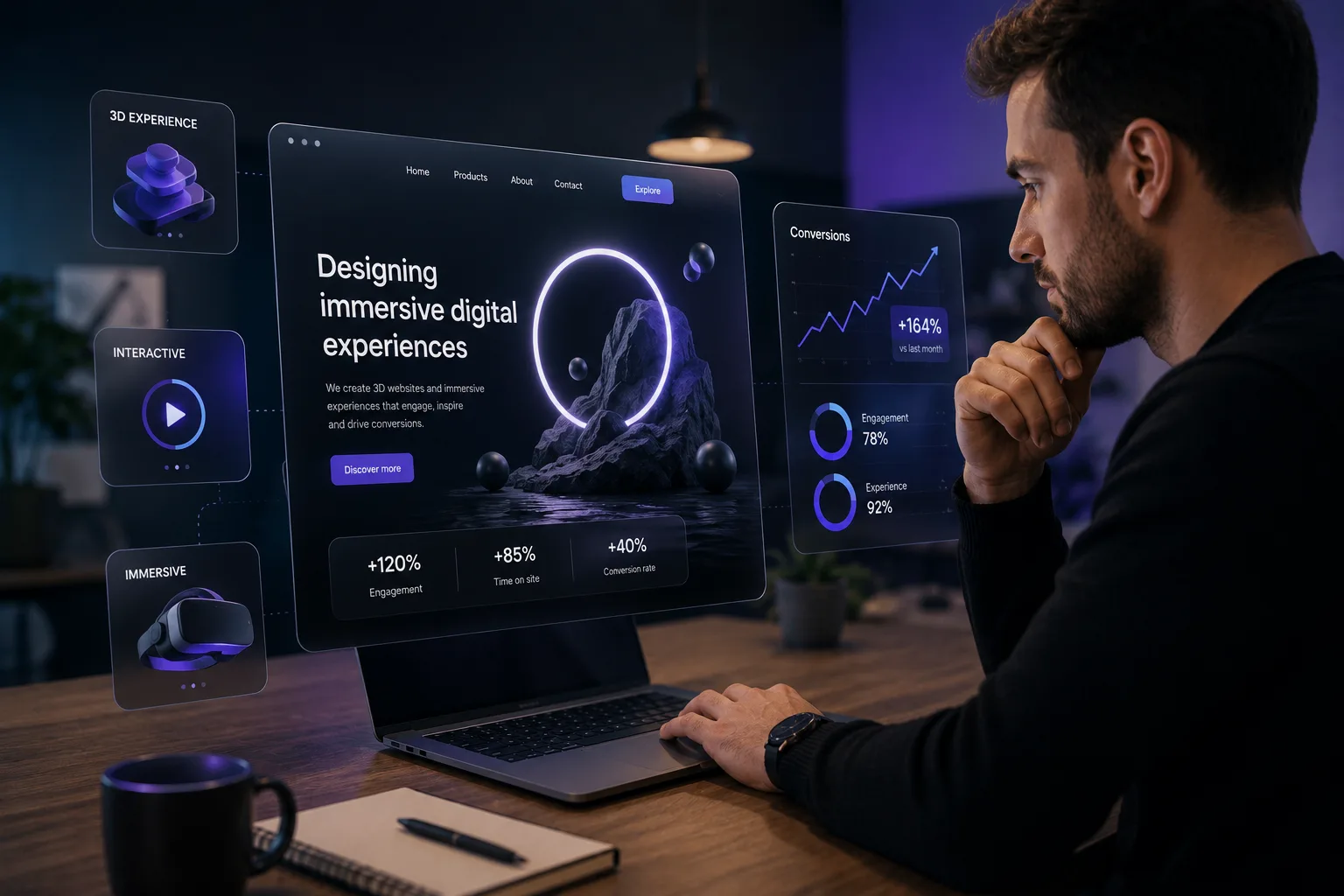
3D websites are everywhere: products that rotate under your cursor, scenes that unfold as you scroll, virtual tours. Thanks to technologies like WebGL and libraries such as Three.js, these experiences now run straight in the browser, with no app to install.
The question every business owner should ask isn’t “does it look good?” but “does it help me sell?” The honest answer: it depends on how it’s used.
The wow effect isn’t enough
A spectacular animation on the homepage grabs attention for a few seconds. But if visitors then can’t work out what you offer, or how to book or buy, that attention is wasted. Worse, a heavy experience can drive them away before they’ve even seen your offer.
So 3D isn’t an end in itself. It earns its place when it answers a question the customer has, or makes them want to go further.
When 3D genuinely drives sales
Some use cases turn 3D into a real sales tool:
- simulators and configurators that let people customise a product and see the result before buying;
- showcasing a venue, for example a bar that hosts private events and wants to show its space from every angle;
- products where the details matter and customers want a closer look: materials, finishes, proportions;
- brands built on a premium, innovative image, where the experience is part of the promise.
In each case, immersion removes a doubt or sparks desire. That’s exactly where it becomes a conversion driver. Imagine a city-centre jeweller letting visitors spin a ring, zoom in on the setting and compare two finishes: the experience covers part of what a customer would otherwise come into the shop to check.
A good 3D experience isn’t trying to dazzle. It’s helping people decide.
The cost of immersion: performance and accessibility
3D comes with a technical cost you shouldn’t underestimate. Heavy models slow down loading, especially on mobile and on a patchy connection in the metro. And loading speed and visual stability matter as much to your visitors as they do to Google, which measures them notably through Core Web Vitals.
A well-built 3D site therefore plans for optimised models, progressive loading, a lighter version for less powerful devices and respect for users who prefer reduced motion. The essential content, meaning your copy, your offer and your call-to-action button, must stay readable and indexable even if the 3D doesn’t load.
The right questions before you dive in
Before investing in an immersive experience, take the time to answer a few questions honestly. They’ll save you from a beautiful website that brings in nothing:
- What does my customer need to see, handle or understand before taking action?
- Wouldn’t a quality photo or a short video do the job just as well?
- Do most of my visitors arrive from Instagram, on mobile, with only a few seconds of attention to give?
- Who will update the 3D models when my offer or menu changes?
If 3D gives a clear answer to the first question, you’ve probably found a real lever. If not, your budget is better spent on speed, content and SEO. And nothing stops you from going step by step: a fast, solid website first, then a targeted touch of 3D where it will have the most impact.
Our approach: immersion that serves the journey
At Cubix, we always start from the goal: a booking, a quote request, an online purchase. 3D comes second, wherever it strengthens that journey, never instead of it. The call to action stays visible, key information stays readable at a glance, and we test the experience on real phones before anything goes live.
Passing trend or conversion driver? Both, depending on the execution. Not sure whether to take the leap? Tell us about your business on WhatsApp: we’ll tell you straight whether 3D makes sense for you, or whether a more classic site will do the job better.