
Between 22 September and 19 October 2026, our website’s Search Console recorded these searches, typed exactly like this: “automatisation pme bruxelles”, “automatisation ai bruxelles” and, in Dutch, “klantcommunicatie automatiseren” and “klantcommunicatie automatiseren met ai”. SME owners are asking the same question: what can you hand over to automation without damaging the relationship with your customers, and without breaking the rules?
Belgian companies are ahead. In 2025, 34.54% of Belgian enterprises with 10 or more people used at least one artificial intelligence technology, against 19.95% across the European Union (Eurostat, 2025 data, table updated on 15 June 2026). In Brussels, it is more than one company in four among those with at least two employees, and 24.3% of companies with 2 to 9 people (IBSA, 4 August 2026). For marketing and sales, use remains rarer: 9.12% of Belgian enterprises with 10 or more people in 2025, according to the same Eurostat table.
1. Start with the messages that keep coming back
Useful automation starts from a task your team does by hand today, several times a week, always the same way. In an SME, it is almost always the same ones:
- Recurring questions: opening hours, service area, usual lead times, documents to prepare. The answer is written once, with your information.
- Appointment confirmations and reminders, sent without anyone having to think about it.
- A follow-up on a quote left unanswered, at the planned moment.
- Moving a request received through a form into your calendar, spreadsheet or customer file, without retyping anything.
- The messages that follow a job: thank you, care instructions, review request.
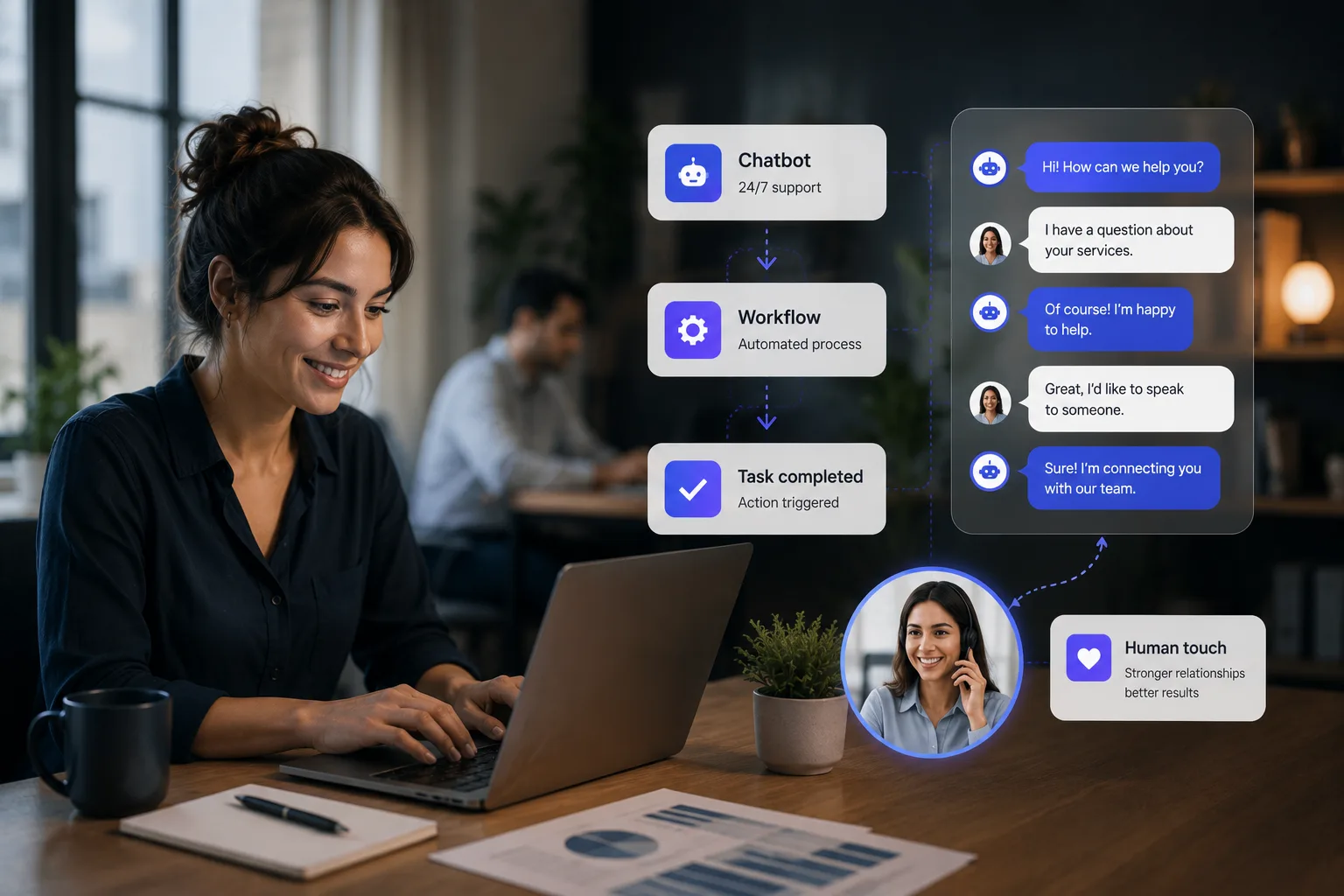
What does not get automated: a complaint, a complex quote, a negotiation, a hesitant customer. There, the tool must hand over, quickly, to the right person. That is also what some of the rules below require (GDPR, WhatsApp).
2. A chatbot must say it is a chatbot
The European regulation on artificial intelligence requires that people be “informed that they are interacting with an AI system”, unless it is obvious, and that this information be given “in a clear and distinguishable manner at the latest at the time of the first interaction” (Article 50, paragraphs 1 and 5). These rules have applied since 2 August 2026. The simplification regulation adopted on 8 July 2026 did not postpone them: it only gives providers of content-generating systems already placed on the market before 2 August 2026 until 2 December 2026, and only for their technical marking (Regulation (EU) 2026/1744).
In its guidelines of 20 July 2026, the European Commission explicitly lists customer support among the uses concerned. It gives the example of a chatbot that starts the conversation by mentioning that it is based on AI, and states that a disclosure placed only in the terms and conditions is not enough. An employee who uses AI to help write replies is not covered, if they review and send the replies themselves: the customer is talking to a human.
In most cases, one clear opening sentence is enough: “I am the company’s automated assistant, powered by artificial intelligence. To talk to someone from the team, type ‘human’.” It tells customers they are dealing with AI and shows them how to reach a person; the Commission considers a generic “assistant” that does not say it is AI insufficient. Our reading: if you use a vendor’s chatbot without modifying it, it is up to that vendor, the provider, to build in this disclosure, and up to you to check that it is displayed; if you have a chatbot developed and put into service under your own name, you are the provider. Breaches can be fined: Article 99 provides for fines of up to 15 million euros or 3% of worldwide turnover, and for an SME the lower of the two amounts is the ceiling.
3. GDPR: the automation answers, a human decides
The GDPR gives everyone the right “not to be subject to a decision based solely on automated processing” that produces legal effects or similarly significantly affects them (Article 22). Where such a decision is allowed, the person must at least be able to “obtain human intervention”, express their point of view and contest it. According to the Belgian Data Protection Authority, processing is not solely automated if it involves a person with sufficient authority to change its outcome (brochure of April 2026).
Our reading: a chatbot that informs, answers or books an appointment decides nothing of the kind. But if it alone refuses a quote, a warranty or a refund, Article 22 becomes relevant again: keep a person who validates. And the rest of the GDPR always applies, because, as the Authority points out, these systems often process conversation histories: say so in your privacy policy, and do not keep conversations longer than necessary.
4. Emails and WhatsApp: no advertising without consent
In Belgium, the use of email for advertising is prohibited without the prior, free, specific and informed consent of the recipient (Code of Economic Law, Article XII.13), and it is up to the company to prove that the advertising was requested. An exception exists for your customers: the royal decree of 4 April 2003 waives consent if you obtained their details during a sale, if you only offer them similar products or services, and if you gave them, at the time of collection, a simple and free way to refuse. The Data Protection Authority restated this exception in its opinion no. 02/2026 of 12 January 2026.
The same rule covers emails and text messages without question, writes the Authority, which cites the FPS Economy’s view that it would also cover “chat”. Our cautious reading: a promotional WhatsApp message follows the same rule. An appointment confirmation or an answer to a question is not advertising; a promotional offer is.
WhatsApp adds its own rules (WhatsApp Business Messaging Policy, updated on 23 September 2026). You may only contact people who gave you their number and agreed to receive your messages. On the WhatsApp Business Platform, the API that automation tools connect to, you reply freely within 24 hours of their last message; after that, only with approved message templates. You may automate your replies there, but you must also offer “prompt, clear, and direct escalation paths” to a human: a colleague in the chat, the phone, email or the shop. Since 1 October 2026, these service messages are charged per message by Meta on the platform, with 1,000 free messages per month per number.
5. Measure what automation changes
Automation is judged on figures you already have, or that the tool gives you: time to first reply, share of requests handled without intervention, number of conversations handed to a human, quotes followed up and those that convert, unsubscribes. If customers often ask for a human on a specific question, the automatic answer needs rewriting, or that question should stay human.
The seven checks
- Each automation starts from a specific task done by hand today.
- The chatbot states in its very first message that it runs on artificial intelligence.
- A way to reach a human is always offered: a word, a button or a number.
- No decision that weighs on the customer (refusal, refund, warranty) is taken without a person who validates it.
- Promotional emails and messages only go out with consent, or to customers under the exception, with an unsubscribe link.
- On the WhatsApp Business Platform: customer opt-in, approved templates outside the 24-hour window, and message costs planned.
- The privacy policy says which conversations are kept, and for how long.