Answering the same questions ten times a day. Confirming appointments one by one. Chasing customers who haven’t been back in months. For a restaurant, a salon or a shop, these tasks eat up hours every week, hours that aren’t spent with customers.
Automation promises to give those hours back. Yet many business owners hesitate, and they’re right to ask questions: nobody wants to hit a cold robot when they message their local barber. That’s the whole challenge: automate what should be automated, and protect what makes you different.
What’s worth automating
The rule is simple: anything repetitive, predictable and free of emotional weight is a good candidate. For example:
- appointment and booking confirmations and reminders;
- answers to frequently asked questions: opening hours, directions, parking, payment methods;
- asking for a Google review a few hours after a visit;
- sorting incoming requests and routing them to the right person;
- welcome and follow-up emails for customers who have agreed to receive them.
Once automated, these tasks run in the background, never forgotten and never late, even on a Sunday evening when you’re closed.
Take a hypothetical restaurant in Saint-Gilles that receives bookings by phone, Instagram and WhatsApp. A well-designed workflow can centralise those requests, send an instant confirmation, a reminder the day before and, the day after the meal, a short thank-you message with a link to its Google profile. The team, meanwhile, focuses on the dining room.
What must stay human
On the other hand, some situations need a real person: an unhappy customer, an unusual request, organising a private event, a regular who’s just writing to say hello. Automating those conversations means risking offending precisely the customers who matter most.
Automation should free up time for those moments, not make them disappear.
Automate the tasks, never the relationship.
A chatbot that knows when to hand over
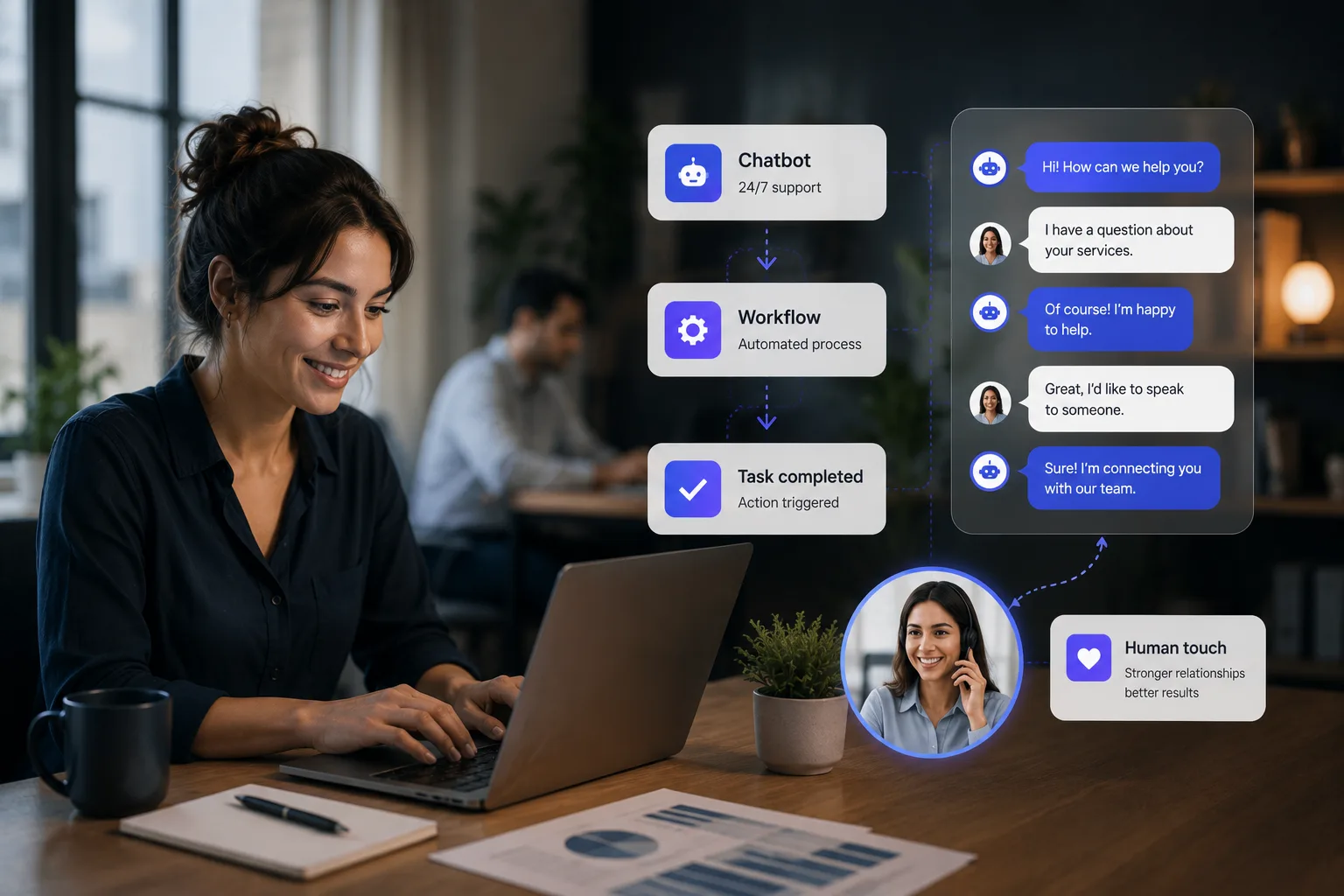
A good chatbot, on your website, Instagram or WhatsApp, doesn’t try to handle everything. It answers simple questions quickly, gathers the useful details, then passes the conversation to a team member as soon as things get complicated. Customers should never feel trapped in a loop of automated replies.
A few principles we apply every time: make it clear that it’s an automated assistant, give it your brand’s tone rather than generic corporate language, provide an obvious way to reach a human, and review conversations regularly to improve it. AI-powered chatbots can now understand freely worded questions, but they need guardrails: an assistant that says “I’ll pass this on to the team” is far better than one that makes up an answer.
Emails and messages that sound like you
Automated email sequences work when they don’t sound automated. A welcome message signed by the owner, a follow-up that mentions the last visit, an invitation to try the new menu: technology handles the sending, but the substance should stay personal.
Mind the legal side too. In Belgium, as across the European Union, the GDPR governs how personal data is used, and sending marketing emails generally requires the person’s prior consent. A well-built customer list made up of people who genuinely chose to hear from you is worth far more than a long list that ignores your messages.
Start small, adjust often
There’s no need to automate everything at once. Identify the task that costs you the most time, automate it properly, watch how customers respond, then move on to the next one. A good workflow is built step by step and refined through use.
Want to know what could run on autopilot in your business? Message us on WhatsApp, where a real human will answer, and together we’ll pinpoint the first automations that save you time without losing any of your warmth.