
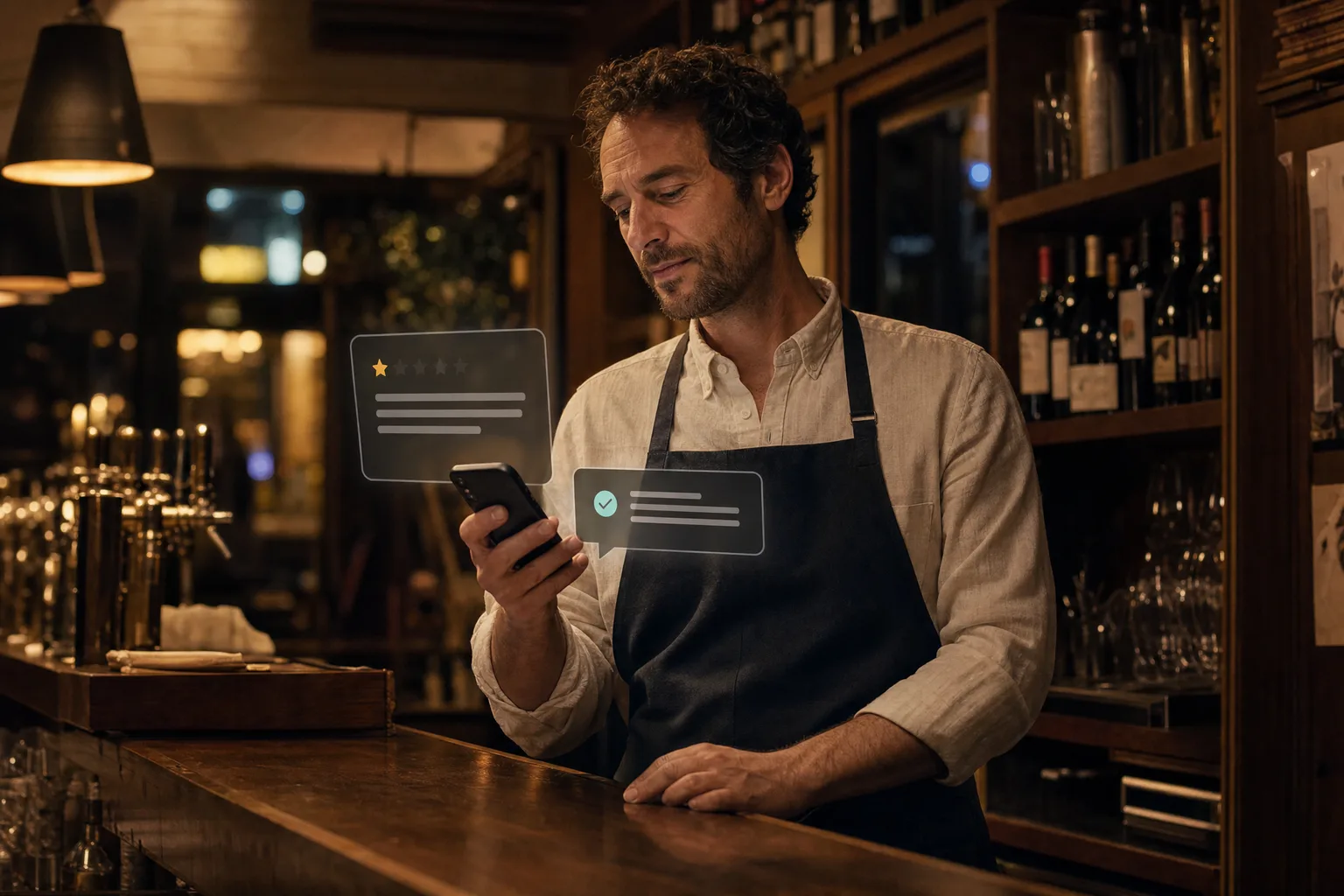
A one-star review lands on a Sunday evening. The owner reads it three times, sleeps badly, and the next morning has two urges: reply with five sharp lines, or do nothing and hope it fades. Both are mistakes, and we see them every week on the listings of the restaurants, salons and shops we follow in Brussels.
This month we wrote the review replies for three Brussels restaurants, including several one-star reviews, one in Dutch, two in Turkish. We turned that into a short method, here it is, with six replies you can reuse almost as they are. None is a magic formula: a good reply does not make the review disappear, it changes what the next customer takes away from it.
The reply is not for the unhappy customer, it is for the next 200
This is the point that changes how you write. The person who left the review will probably not come back, whatever you answer. But everyone hesitating between your place and the one next door will read your listing, go straight to the negative reviews (everybody does), and read your reply underneath. They are not judging the review. They are judging how you handle a problem.
A one-star review followed by a calm, precise, signed reply reassures more than ten five-star reviews with no reply. And a one-star review followed by an aggressive reply costs you customers you will never see, because they never walked in.
Within 48 hours, never in the heat of the moment
Reply fast, but not right away. The right window is between a few hours and two days: quick enough for Google and readers to see the listing is looked after, slow enough for the reply to be written cold. Our rule with the clients who hand us their reviews: we write the draft, have it read by someone who was not in the room that night, and publish the next day.
A short reply beats a long one. Four to six sentences are enough. Beyond that you look like you are justifying yourself, and nobody reads.
The four-part structure
- The first name and a sincere thank you, not a robotic "thank you for your feedback". "Hello Jessica, thank you for taking the time to write."
- The precise fact you acknowledge. Not "we are sorry about your experience" but "a forty-minute wait for a main course on a Friday night is not acceptable". Restating the complaint shows you read it.
- What you did or changed. One concrete action: an extra server at weekends, a corrected menu, a word with the team. If you changed nothing, do not invent it; say what you are checking.
- A way out offline, signed with a first name. "Write to me at this address or call me at the restaurant, I want to understand what happened. Karim, manager." The first name makes all the difference: it is no longer a brand replying, it is a person.
What never to write
- Contradicting point by point. Even if you are right, the reader sees an owner arguing with a customer.
- Revealing anything about the person: what they ordered, who they came with, what they paid, how they behaved. It is bad for your image, and it is personal data you have no right to publish.
- Offering something in exchange for editing the review. A free drink "if you remove your comment" breaks Google’s rules and consumer law. We saw it written in black and white in a public reply this summer: it is the kind of sentence that gets a listing reported.
- Copy-pasting the same reply everywhere. Readers spot it in three seconds, and so does Google.
- Threatening legal action or calling the review fake in public. If the review is fake, you report it (see below), you do not write it in the reply.
- Writing in capitals, with strings of exclamation marks or emojis. The tone of the reply is read as the tone of the house.
Six replies to adapt
Replace the names, the facts and the signature. Keep the length.
1. The complaint is justified: waiting, wrong order, cold service
Hello Jessica, thank you for taking the time to write. Forty minutes for a main course on a Friday night is not what we want to offer, and I understand the evening was spoiled. We have added a server on weekend evenings since. If you are willing to come back, write to me at the restaurant and I will take care of it personally. Karim, manager.
2. The complaint is partly justified, or rests on a misunderstanding (price, portion, dish)
Hello Thomas, thank you for your message. You are right on one point: the lunch menu price was not clearly displayed that day, we have corrected it on the board and on the Google listing. On the portion, we have served the same one since we opened, but I understand it looked small that day. I would be glad to talk about it with you directly, at the restaurant or by email. Nadia, manager.
3. The review is unfair or false: never came, wrong business, competitor
Hello, thank you for your message. We could not find a visit matching your description on that date, and it is possible the review concerns another establishment. If you did come to us, write to me at this address with the day and time, I want to understand what happened. Karim, manager.
Then you report the review to Google, without saying so in the reply. The reader sees a courteous owner leaving the door open, and concludes on their own that the review is doubtful.
4. The review is in Dutch: reply in Dutch
In Brussels and its outskirts, one review in five is not in French. Replying in the language of the review is the most profitable move on this list: it shows Dutch-speaking readers that the house welcomes them in their language. Have it proofread by someone who actually speaks the language; machine translation shows.
Dag Hakan, bedankt voor uw bericht. Een koude schotel en een lange wachttijd op een zaterdagavond, dat is niet wat we willen aanbieden, en ik begrijp uw ontgoocheling. We hebben de keuken sindsdien anders georganiseerd voor het weekend. Als u ons nog een kans wilt geven, stuur me een berichtje, dan zorg ik er persoonlijk voor. Karim, zaakvoerder.
5. The review is in English: same rule
Hi Ari, thank you for taking the time to write. A forty-minute wait for a main course is not the experience we want to offer, and I understand the frustration. We have added a second server on weekend evenings since then. If you are willing to come back, send me a message at the restaurant and I will take care of it personally. Karim, manager.
6. One or two stars without a word
The review without text is the most frustrating: you do not know what to fix. Reply anyway, briefly, without assuming.
Hello Mehmet, thank you for your rating. I do not know what fell short, and I would like to: write to me at the restaurant or by email, even two lines. Karim, manager.
When and how to report a review to Google
Google does not remove a review because it is negative. It removes one that breaks its rules: off-topic content, a review about another business, a conflict of interest (a competitor, a former employee), spam, hateful content or personal data. From your listing, open the review, click the three dots, then "Report review", and pick the most precise reason. You can follow the request in Google’s review management tool.
Count on three days to several weeks, and often a refusal at the first request. Reporting therefore does not replace replying: the reply is online the same day, the removal maybe never.
What matters more than the reply: the next reviews
A negative review weighs less when it is surrounded by recent ones. Google looks at freshness as much as the score: a 4.5 listing with reviews from last week inspires more trust than a 4.8 whose last review dates from winter. So the best answer to a one-star review is also to send your review link to your last three happy customers, with a personal word, not a QR code on the counter.
And fix the cause. A perfect reply to "forty minutes of waiting" is useless if the next Friday it is forty minutes again. Reviews keep coming back to the same point until the point is fixed.
Do you have a review stuck in your throat and no idea what to answer? Send it to us on WhatsApp with two lines of context. We send back a draft reply within the day, no strings attached. It is what we do every week for the restaurants and shops we work with.