
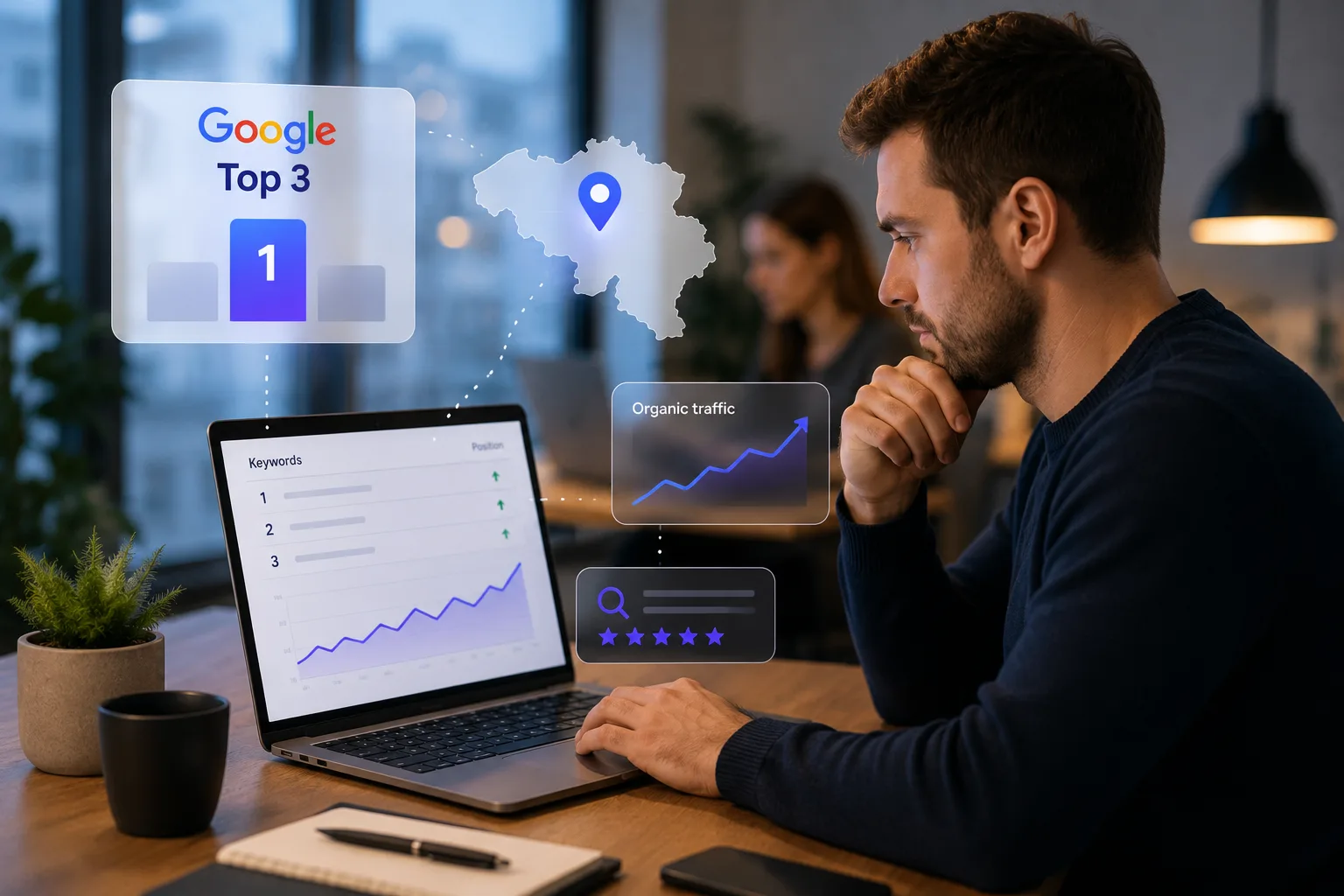
Many business owners tell us the same thing: “My website ranks well.” So we type their business name into Google, they come up first… and that’s about it. Being found by someone who already knows you isn’t SEO.
The real challenge is showing up in front of someone looking for a service like yours, who has never heard of you, at the exact moment they’re ready to buy. On those searches, everything happens at the top of the page: the first results capture most of the attention, and beyond page one you’re practically invisible. Hence our goal: the top 3, on the keywords that actually make you money.
Start with the keywords that sell
Not all keywords are equal. “How to look after your beard” attracts the curious; “barber Saint-Gilles” or “book barber Brussels” attracts customers. The first is an informational search, the second shows transactional or local intent. That second group is where you start.
To find them, we combine several sources:
- the services with the best margins in your business, not just the most requested ones;
- Google’s autocomplete suggestions and the related searches shown at the bottom of the page;
- the queries already bringing you visitors, visible in Google Search Console;
- the pages of direct competitors currently holding the top 3.
The result: a short, prioritised list. Better to dominate ten profitable searches than to stall on a hundred.
Search in Belgium has its own rules
The Belgian market isn’t a smaller version of France or the Netherlands. In Brussels, your customers search in French, in Dutch and often in English. They type the name of their commune rather than the city, or simply add “near me” on their phone.
The consequences are very practical. A multilingual website needs genuine versions for each language, properly signalled to Google with hreflang tags, not a rough machine translation. Your service pages benefit from targeting specific areas, with content that’s genuinely useful for each, rather than copy-pasted pages where only the commune name changes.
Finally, your Google Business Profile becomes a cornerstone: accurate categories, up-to-date opening hours, recent photos and customer reviews that you actually reply to. Google itself states that relevance, distance and prominence, reviews included, influence how businesses rank in local results.
E-E-A-T: prove you’re the right choice
In the guidelines it publishes for its search quality raters, Google describes what trustworthy content looks like through four ideas: experience, expertise, authoritativeness and trustworthiness. That’s E-E-A-T. It isn’t a technical setting; it’s a way of building your whole online presence.
For a local business, it translates very simply: show your real work with your own photos and videos, introduce the team and their craft, display complete contact details that match everywhere on the web, highlight verifiable reviews, and write content that answers the questions customers ask you at the counter. A faceless site with stock photos and vague copy starts with a serious handicap.
Google doesn’t reward whoever shouts the loudest. It rewards whoever proves it best.
Solid technical foundations
The best content in the world won’t rank on a slow or badly structured site. Before producing anything, we check the basics: a fast site that feels good on mobile, healthy Core Web Vitals, a logical page structure, carefully written title tags and meta descriptions, internal links that lead to the pages that convert, and LocalBusiness structured data to help Google understand who you are and where you are.
This work is rarely spectacular. Yet it’s often where the quickest wins are hiding.
Content that matches search intent
Once the foundations are in place, every priority keyword deserves a page built for it. A page that answers exactly what the searcher wants: the service, your prices if you can show them, the area you cover, proof that you’re serious, and a button to take action without having to look for it.
The blog then comes in as support. Useful articles that answer your customers' real questions reinforce your expertise in Google’s eyes and feed your key pages with internal links. And while organic rankings build up, a well-targeted Google Ads campaign can capture the hottest searches right now.
Measure, adjust, stay the course
Let’s be honest: nobody can guarantee a position on Google, and serious SEO takes time. What we can guarantee is a method. Tracking positions on your target keywords every month, along with clicks and the enquiries they generate; doubling down on what’s climbing; fixing what’s stuck. In a local market where plenty of competitors still neglect the basics, a rigorous approach often makes the difference.
Curious where you stand on the searches that really matter for your business? Message us on WhatsApp: we’ll review your current rankings and show you the opportunities within reach.