In 2024, the Economic Inspectorate of the FPS Economy checked 2,664 establishments in Belgium, mostly in food retail, hospitality, hairdressing and clothing. According to its report, published on 5 August 2025, 67.3% were in breach. Price display topped the list, and on that point the breach rate reached 49.5% for restaurants, brasseries, taverns, cafés and bars. The FPS qualifies these figures: only 128 establishments (4.8%) had committed breaches serious enough to warrant an immediate official report. Another weak spot: of the 2,158 websites and social media pages reviewed, 47.7% did not give the required information about the business.
These checks cover only some of the rules that apply to what you show and publish: the menu in your window, the lunch menu on Instagram, the ordering page, your Google reviews, the video of the influencer you invited. Here are the seven points to check, each with the exact reference of the text, so you can read it yourself.
The texts cited are those in force on 2 October 2026. This article summarises them; for a specific case, it does not replace advice from a lawyer.
1. Prices can be read from outside
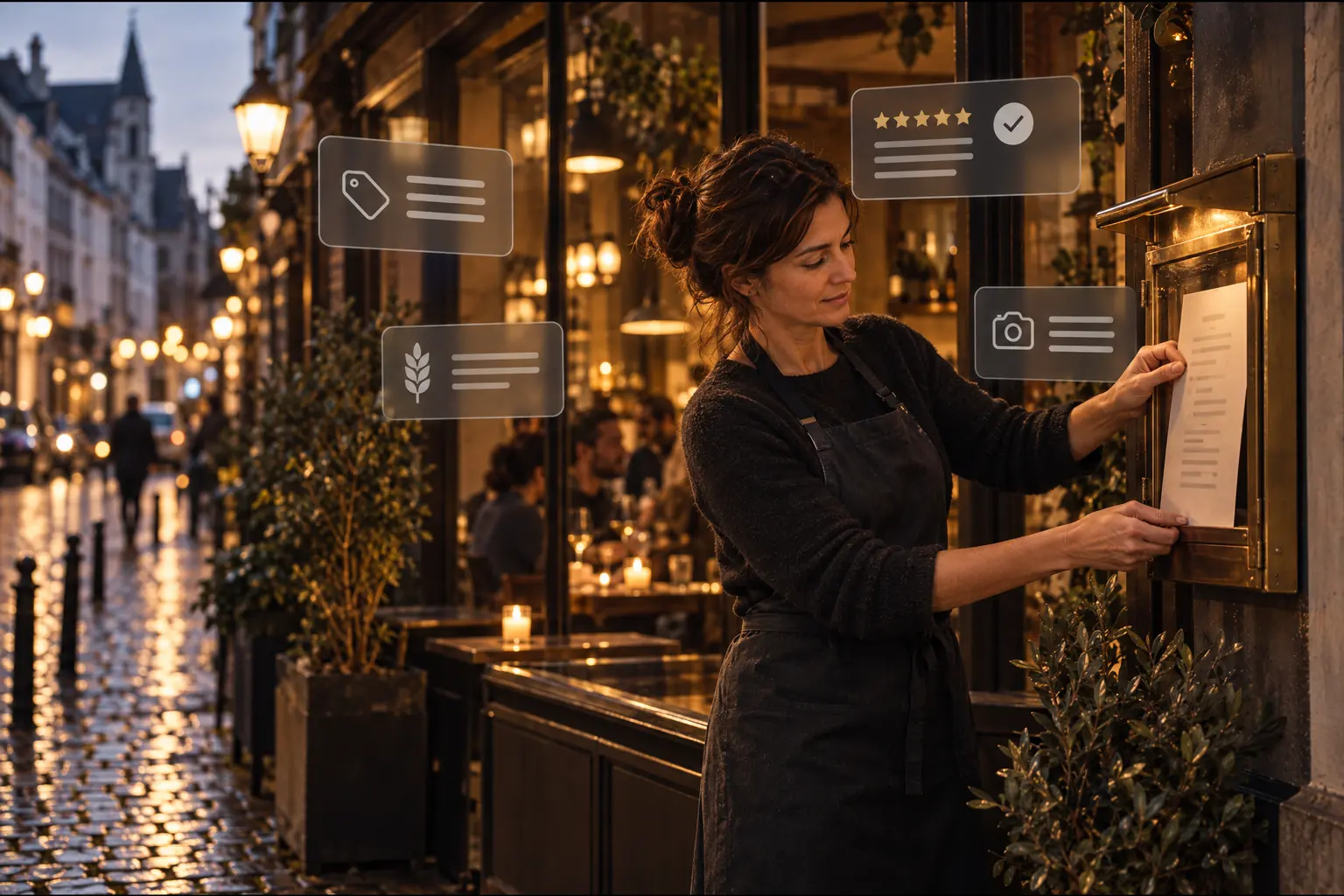
The Royal Decree of 7 December 2016 on price indication in the hospitality sector is short. Any establishment serving meals, dishes or drinks must show its prices in writing, legibly, visibly and unambiguously, in a place clearly visible from outside (Article 1). For the FPS Economy, this means customers must be able to see the prices before they walk in: in the window, on the façade, or in the entrance hall they pass through to reach the dining room. For drinks, the outside display may be limited to the most representative ones in each category. Inside, a complete price list of all meals, dishes and drinks must be available to customers in any case (Article 3).
A QR code alone is not enough, whether in the window or at the table. The FPS Economy’s guidelines on price indication in the hospitality sector (version of 17 July 2026) are clear: customers cannot be required to scan a code with their own phone to find out the prices. A QR code can only supplement a menu or price display that customers can read directly.
The price must also be complete. Article VI.4 of the Code of Economic Law requires the total price to be paid, including VAT, other taxes and any compulsory service charge. Article VI.6 extends the rule to any advertising that mentions a price: your story announcing a “lunch menu at €19” must show what the customer will actually pay. And on an ordering website, Article XII.6 requires you to state whether taxes and delivery costs are included.
2. Allergens come before the order, in the dining room and online
Regulation (EU) No 1169/2011 makes information on the fourteen allergens in its Annex II mandatory, even for dishes served unpackaged (Article 44). In Belgium, the Royal Decree of 17 July 2014 sets out how. The basic rule is writing: on a physical or electronic medium, clearly legible, accessible before the purchase (Article 3). On the menu, for example, or under the name of the dish of the day on the board.
Giving it orally is allowed (Article 4), under five conditions: the information is given without delay and before the purchase when the customer asks; an internal procedure is set up and applied; it is written down and accessible to staff and inspectors; the staff concerned are trained on the risks of food allergies and intolerances, and on that procedure; and the information costs the customer nothing. Whenever allergens are not displayed in a clearly visible place, for example when they are given orally, a clearly visible notice must say where to find the information or invite customers to ask the staff, and warn that the composition of dishes may change (Article 5). The only other exemption: you ask customers in advance about their allergies and intolerances, and you can serve each of them suitable dishes (Article 5, § 3).
Online, the information must come before the order is confirmed, on the website itself or by another clearly stated means, at no cost to the customer (Article 14 of the EU regulation). The 2014 decree adds that the Article 5 notices must also appear on the distance-selling medium, except in the same two cases: allergens displayed there in a clearly visible place, or allergies asked about in advance with suitable dishes provided (Article 5, § 2 and § 3). The simplest approach: the same “allergens” column on the menu, on the ordering site and on your delivery pages.
3. Google reviews are requested, not bought
Asking for a review is allowed: Google’s help page “Tips to get more reviews” suggests asking customers to visit a Google link or scan a QR code. What is forbidden is giving something in return. Google Maps content rules exclude reviews or ratings that were paid for, directly or in kind, and forbid offering a benefit (payment, discount, free product or service) in exchange for a review, or to have a negative review changed or removed. A free dessert for a review falls under this, even without asking for five stars.
The same rules forbid soliciting positive reviews selectively, or requiring or pressuring customers to leave a rating or review while on the premises, and exclude content based on a conflict of interest, such as reviews from your staff.
Belgian law, for its part, targets fake reviews and a lack of transparency. Article VI.100 of the Code of Economic Law lists, among practices that are unfair in all circumstances, posting or having others post fake reviews, or distorting consumer reviews in order to promote products (point 26), and claiming that reviews come from real customers without having taken reasonable and proportionate steps to check this (point 25). If your website shows reviews, Article VI.99 (§ 7) treats as material the information on whether, and how, you ensure that they come from customers who actually ate or bought from you: state it next to the reviews. For reviews shown on your website, the FPS Economy adds that publishing only some of the genuine reviews, without saying so clearly, may be an unfair practice, and that paid or sponsored reviews, including those rewarded in kind or with vouchers, must be clearly labelled.
4. A free meal makes an influencer’s post advertising
For the FPS Economy, a post is advertising as soon as a content creator promotes or talks about a product, service or brand, your restaurant for example, and receives a benefit in return. Its list of examples explicitly includes a free meal in a restaurant. No contract needs to have been concluded, and it does not matter whether you explicitly asked for the post or control it.
The post must then make clear that it is advertising. The FPS recommends a word everyone understands, such as “advertising”, visible straight away without clicking, not lost at the end among the hashtags, and in the language of the post. The principle appears in particular in Article XII.12 of the Code of Economic Law: online advertising must be identifiable as such as soon as it is received, or else carry the word “advertising”, and the party it is made for, here your restaurant, must be clearly identifiable.
Checks are continuing: in an international survey coordinated by the FPS Economy and published on 30 June 2026, 80% of the influencers checked in Belgium did not systematically state that their content was advertising. So put it in the invitation: the meal is free, the advertising label is expected, your account is tagged.
5. Photos of customers and staff need two consents
Image rights are in the Code of Economic Law: no one may reproduce or publish someone’s portrait without their consent (Article XI.174). The Data Protection Authority points out that agreeing to be photographed does not necessarily mean agreeing to publication: these are two separate consents, to be asked for separately. And the image may not be used for any purpose other than the one agreed to.
Consent does not have to be written if it is certain, but you must be able to prove it was given. For your team, a short signed document setting out the uses (website, social media, paid advertising) removes any doubt. For a full dining room, frame the shot so no one can be recognised, or ask.
6. Your website and Instagram page say who you are
Article XII.6 of the Code of Economic Law requires a business website to give easy, direct and permanent access to at least the business name, the geographical address where the business is established, contact details including an email address, the enterprise number and, if the business is subject to VAT, its VAT number. The FPS Economy points out that this applies even without online sales, and its checks also cover social media pages: in 2024, the enterprise number was missing on 45.7% of the websites and pages reviewed.
On Instagram, where the bio is short, the FPS Economy, in its publication of 25 April 2022 on content creators, accepts a link to your website, provided it is easily, directly and permanently accessible. Put at least your enterprise number in the bio, with a link to the page of your website that gives the rest.
7. The Meta pixel waits for consent
If your website carries the Meta pixel or Google Analytics, the law only allows them after the visitor has given consent, having been clearly informed; the only exceptions are trackers used solely to transmit a communication, or strictly necessary for a service the visitor has expressly requested (Article 10/2 of the Law of 30 July 2018). The Data Protection Authority’s cookie checklist (October 2023) draws three rules from this, among others: no non-essential cookie before consent, pixels included; no button to accept all cookies without a button to refuse all non-essential cookies at the same level; and withdrawing consent as simple as giving it.
A banner that only offers “OK” is therefore not enough, and the pixel must only fire after consent.
The five-minute check
- The window: prices can be read from outside, VAT and compulsory service included; a QR code only supplements them.
- The dining room: a complete price list is available; allergens are written on the menu, or a notice invites customers to ask staff, who are trained and have a written procedure, and warns that the composition may change.
- The ordering site: allergens before confirmation, delivery costs stated.
- Reviews: a link or QR code offered to everyone, with nothing in return and no pressure.
- Influencers: every post linked to a free meal makes clear it is advertising and identifies your restaurant.
- Photos: consent from every recognisable person, in writing for the team.
- Website and social media: name, address, email, enterprise and VAT numbers accessible.
- The pixel: blocked until consent, with a refuse-all button at the same level as accept-all.
Would you like an outside look at your shopfront, website and Instagram? Send us your restaurant’s name: the analysis is free, written, and you keep it whatever happens.